About this book
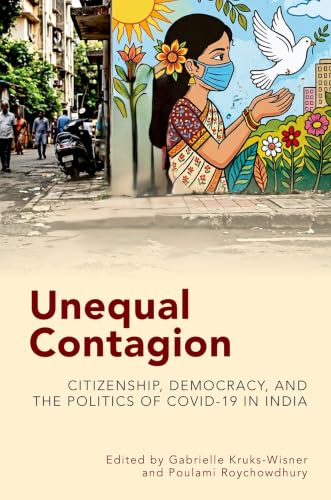
Abstract The COVID-19 pandemic was a global emergency, but its health, social, and economic effects were highly uneven. In India—one of the world’s most unequal democracies—the pandemic and the policies enacted in response unfolded across a hierarchical social landscape and uneven institutional terrain, producing sharply differentiated experiences of risk, protection, and loss. Unequal Contagion: Citizenship, Democracy, and the Politics of COVID-19 in India brings together an interdisciplinary group of scholars to analyze how long-standing patterns of inequality shaped pandemic experiences, how those inequalities were intensified by state responses, and how historically rooted forms of social mobilization and citizen–state relations helped, in some contexts, to mitigate their effects. Employing wide-ranging methods, from surveys to ethnography, the chapters examine how centrally imposed lockdowns, disruptions to health systems, and uneven welfare provision interacted with class, caste, gender, religious, and regional inequalities. Seemingly universal policy responses often amplified vulnerability, particularly among migrants, informal sector workers, women, and other marginalized groups, leaving many without access to livelihoods, healthcare, or protection from violence. But responses varied substantially across states and localities, reflecting differences in state capacity and the strength of connections between citizens, civil society organizations, and government institutions. By linking subnational variation in pandemic policy and welfare outcomes to historically embedded patterns of social mobilization and political engagement, the book advances a relational and intersectional account of governance under stress, offering insights into inequality, citizenship, and democratic politics in India and other unequal societies.