Books
arrow_backBack

Already on your shelf

5 similar books you own: read these first?

Editions & prices

FormatISBNPublisher price
Ebook 9780198996095 —
Print 9780198996088 —

About this book

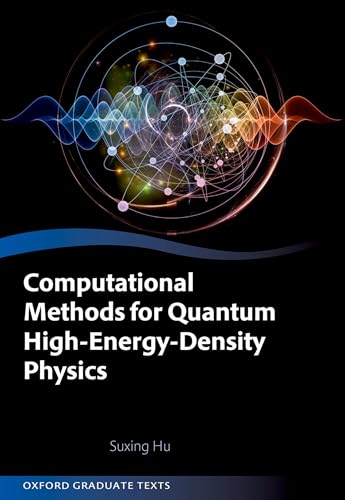
Abstract High-energy-density (HED) science concerns the physics and chemistry of matter subjected to extreme conditions, with pressures ranging from millions to trillions of atmospheres. Experimental and computational studies of the quantum nature of HED matter have discovered many interesting phenomena, ranging from high-pressure induced superconductivity, hydrogen-helium de-mixing, diamond precipitation in carbon-bearing compounds, to a completely new high-pressure periodic table of elements. Better understanding quantum HED matter can have significant impacts on planetary science, astrophysics, and technological applications such as harnessing clean energy through inertial confinement fusion (ICF) and designing new quantum materials. Computational study of HED science, with quantum-mechanical methods, play a vital role in advancing this new field. These first-principles methods include finite-temperature density-functional theory (DFT), DFT-based quantum molecular dynamics (QMD), time-dependent DFT (TD-DFT), path-integral Monte Carlo (PIMC), path-integral molecular dynamics (PIMD), as well as machine-learning (ML) and artificial intelligence (AI) applications to HED science. The book presents practical procedures for calculating material properties of quantum HED matter—such as the equation of state (EOS), transport properties (including thermal and electrical conductivities, diffusion coefficients, viscosity, and stopping power), and radiative properties (opacity and emissivity)—using first-principles quantum mechanical methods. It also gives a chapter to summarize most recent advances in computational HED physics, including finite-temperature exchange-correlation functionals, mixed deterministic-stochastic DFT, and ML/AI applications to HED physics. The final chapter lists nine open questions and challenges currently faced by the field, to stimulate next-generation scientists to solve these “mysteries” in HED science.

Source: crossref · first seen 2026-11-24

Similar new books

not in your library