Books
arrow_backBack

Already on your shelf

5 similar books you own: read these first?

Editions & prices

FormatISBNPublisher price
Ebook 9780197910573 —
Print 9780197910580 —

About this book

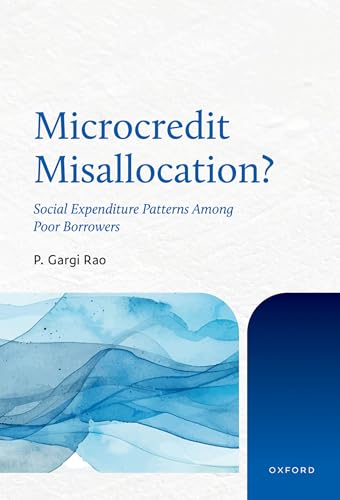
Abstract This book challenges the belief that microcredit necessarily alleviates poverty and enhances self-esteem by considering borrowers’ social, cultural, and non-commercial needs. The research involved an empirical analysis of 100 borrowers in Telangana from a public-sector bank and a state-operated microfinance institution (MFI) to evaluate how loans were actually used versus the projected business investments. Key findings indicate that borrowers prioritize immediate obligations, such as sustenance (16.47%), festivals (13.78%), and marriages (12.77%). In the government MFI group, only 3% of the loan was used for business, while 47% was misallocated to unexpected uses, resulting in a 98% repayment failure rate. Loan diversion is influenced by the intended use, dependency ratio, oversight, and repayment attitudes. Gender and group size affect the likelihood of avoiding financial diversion. The study suggests that insufficient evaluations of borrowers’ holistic needs contribute to this behaviour. To optimize resource utilization, MFIs must develop better strategies and policies informed by these variables to ensure long-term financial stability for small-scale borrowers.

Source: crossref · first seen 2026-11-24

Similar new books

not in your library