Books
arrow_backBack

Already on your shelf

5 similar books you own: read these first?

Editions & prices

FormatISBNPublisher price
Ebook 9780197638194 —
Print 9780197638163 —

About this book

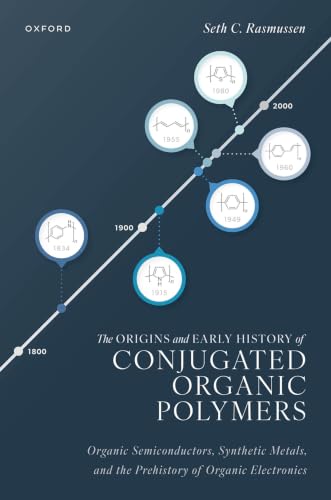
Abstract Conjugated organic polymers are intrinsic semiconducting materials that exhibit enhanced conductivity upon oxidation or reduction. The unusual nature of this class of organic polymers was brought into particular focus in the late 1970s with the first example of conductivity values in the metallic regime, for which the 2000 Nobel Prize in Chemistry was awarded to Hideki Shirakawa, Alan MacDiarmid, and Alan Heeger. As such, it is generally believed that these materials are a relatively recent advancement and originated with this polyacetylene work in the 1970s. This accepted narrative, however, ignores the fact that reports of electrically conductive polymers date back to the early 1960s, with the study of conjugated polymers as a whole dating back to the early 19th century. In fact, the oldest member of this family, polyaniline, predates even polystyrene and is the oldest known fully synthetic organic polymer. Unfortunately, the historical narrative of these polymers is quite muddled in the primary literature, with various inaccuracies and falsehoods commonly propagated. To present a more accurate account as a resource for the field, this book aims to present a comprehensive history of the origin and development of conjugated organic polymers, covering the period from 1834 to the late 1980s. In the process, the history of the first six primary parent polymers (polyaniline, polypyrrole, polyphenylene, poly(phenylene vinylene), polyacetylene, and polythiophene) is presented, as well as the birth of low-bandgap polymers in the mid-1980s.

Source: crossref · first seen 2026-11-24

Similar new books

not in your library