Books
arrow_backBack

Already on your shelf

5 similar books you own: read these first?

Editions & prices

FormatISBNPublisher price
Ebook 9780198954477 —
Print 9780198954446 —

About this book

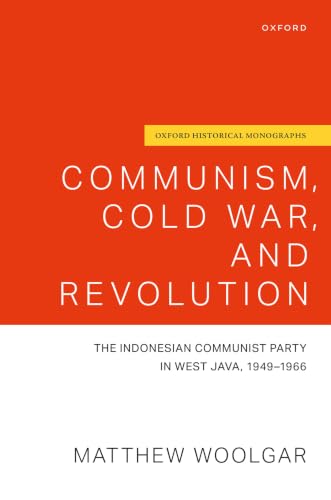
Abstract This study of the Indonesian Communist Party (Partai Komunis Indonesia, PKI) in the 1950s and 1960s argues that the PKI embodied a distinctive and adaptable ‘archipelagic communism’ that achieved impressive growth whilst navigating an increasing pluralism in global communism and a context of extreme local cultural and social diversity. During this period the PKI’s claimed membership grew from a few thousand to over three million, before the party was violently destroyed. The book uses the case study of West Java to illuminate the experience of the PKI at the intersection of world communism, a global Cold War, and Indonesia’s revolution. It combines oral history, contemporary publications, and newly accessible party archives to recreate party life in unprecedented depth. The study addresses Indonesian communism as a phenomenon impacted by both top-down and bottom-up forces amid the interaction of transnational, national and subnational dynamics. The PKI’s trajectory was shaped by its national leadership, which engaged in an ongoing dialogue with comrades abroad. However, the party also creatively navigated cleavages within Indonesian society and tapped into grassroots activist energies. The study shows that the PKI became increasingly bureaucratic and hierarchical, but also that it maintained a hybrid nature, as both an organization and movement that was deeply intertwined with the groundswell of popular mobilization that characterized Indonesia’s ‘long revolution’. The PKI’s destruction occurred at the intersection of rising Cold War tensions and the emergence of a counter-revolution driven by an evolving anti-communist coalition that drove forward a dramatic realignment of Indonesia’s sociopolitical order.

Source: crossref · first seen 2026-11-24

Similar new books

not in your library